
Fundamentals
Kihon, are the fundamentals that apply to every aspect of the art, including posture, breath, distancing, angling, timing, circumnavigation, triangulation, energy transfer, and communitive locking.
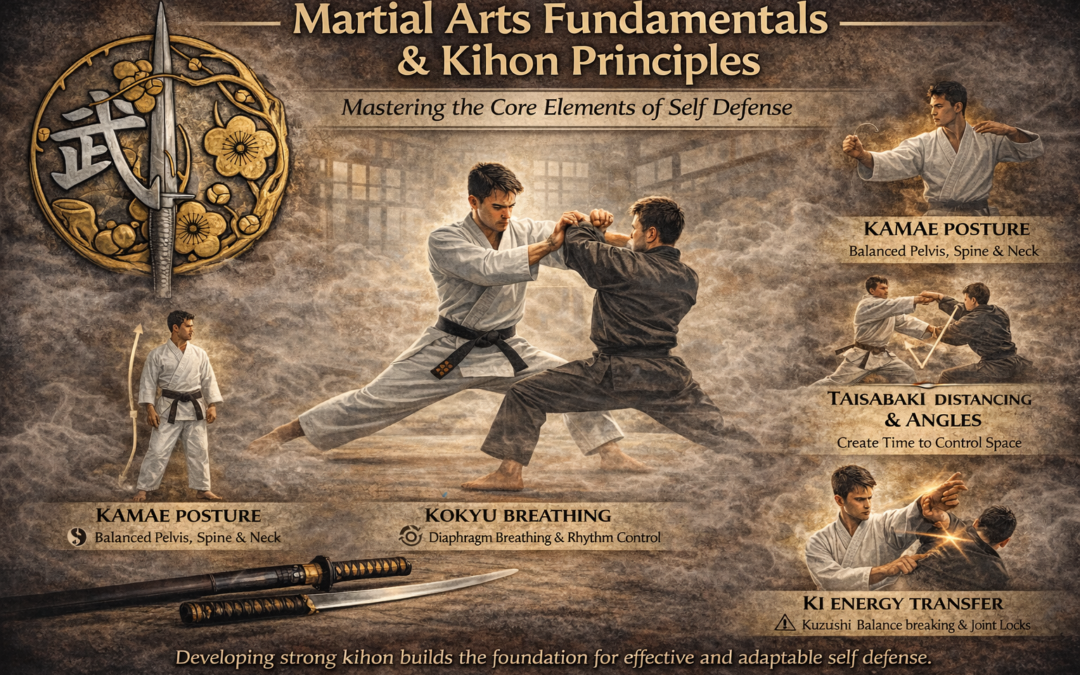
Proper kamae (posture), is essential to the successful application of martial arts. It begins with a naturally erect spine and neck that properly balances the head, and shoulders over the hips. It is important that the hips are properly aligned and not tilted forward placing stress on the lower back. Healthy posture is easily achieved through taiso (body conditioning) which includes flexibility, resistance, and endurance training. Equally important are diet, adequate sleep (on a good mattress), and properly fitted shoes. Fighting postures are not static stances, but are a series of transitory platforms that provide the fighter with a familiar point of reference allowing him or her to adapt to changing situations and engage in combat. One way of achieving positional dominance is through kuzushi (breaking an opponent’s balance). Maintaining control of ones own balance is prerequisite to influencing or breaking the balance of an adversary. In order to maintain balance the fighter must move from the hips as opposed to the shoulders.
Strenuous physical activities demand the proper coordination between movement and breath. Just as an athlete exhales while bench pressing, a martial artist will exhale as they punch or throw. The fighter must be in control of their breathing throughout the engagement. Proper breathing is performed through the rise and fall of the diaphragm, not the chest. High chest breathing does not fully expand the lungs causing the breath to be shallow and rapid. Shallow breathing is often observed in persons of poor health or mentally stressed.
Kukan is the physical space between fighters as it pertains to timing and changes as each vies to gain advantage over the other. Through the correct usage of ma-ai (distancing) and do-ai (angling) a fighter is able to create time. The fighter who controls the ritsudo (rhythm) of the fight is able to mentally and physically dominate their adversary. The easiest way to control kukan is through the application of taisabaki, footwork. Taisabaki-waza is first learned through the practice of sanshin-gata, the three hearts form. It consists of irimi-waza (entering techniques) to close distance with the enemy, shumatsu-waza (changing techniques) to maintain distance but change angles, and tenken-waza (yielding techniques) to increase distance.
Combat is two opposing forces trying to exert their will on the other, circumnavigation is a way of moving around the pressure or resistance exerted by ones adversary. One example of this principal can be seen when one swordsman’s attack is stopped when the adversary executes a block. Using circumnavigation the first swordsman will simply use the point of resistance as a pivot point and flow around it, and will likely cut the opponent in the process. Another way of viewing circumnavigation is when a fighter is grabbed by an opponent. If the fighter simply chooses to ignore the seized body part and chooses instead to attack the adversary in a completely different manner he or she has demonstrated circumnavigation. The defender may also rotate the seized limb in a way that utilizes mechanical advantage to move around the point of resistance.
Triangulation is the principal that allows the fighter to achieve kuzushi. First picture a three-legged stool, now imagine a two-legged adversary. A persons center of balance is just below the naval in line with the hips. By moving a persons center of balance laterally they must step in order to maintain their balance. To apply triangulation a fighter moves the adversary’s center of balance to a point that would require three legs to hold them up. In this position even if the adversary is able to step they will still only have two legs to stand on and their balance will be broken.
Ki is energy, all energy. Many times it is described in mystical terms, but in this case it is simply mechanical energy transferring from one person to another. In its simplest form it is the inertia of a moving fist impacting a static object. In a slightly more complicated example, it is that fist impacting at a specific point, at a specific angle to achieve triangulation. At a higher level it is aiki (reciprocal energy), this is the subtle blending with an opponents momentum in order to achieve kuzushi.
Additionally there is a principal that applies to joint manipulation; it is the concept of communitive locking. This involves controlling a series of joints instead of a single joint. By controlling a series it is possible to apply all the other principals including triangulation.