
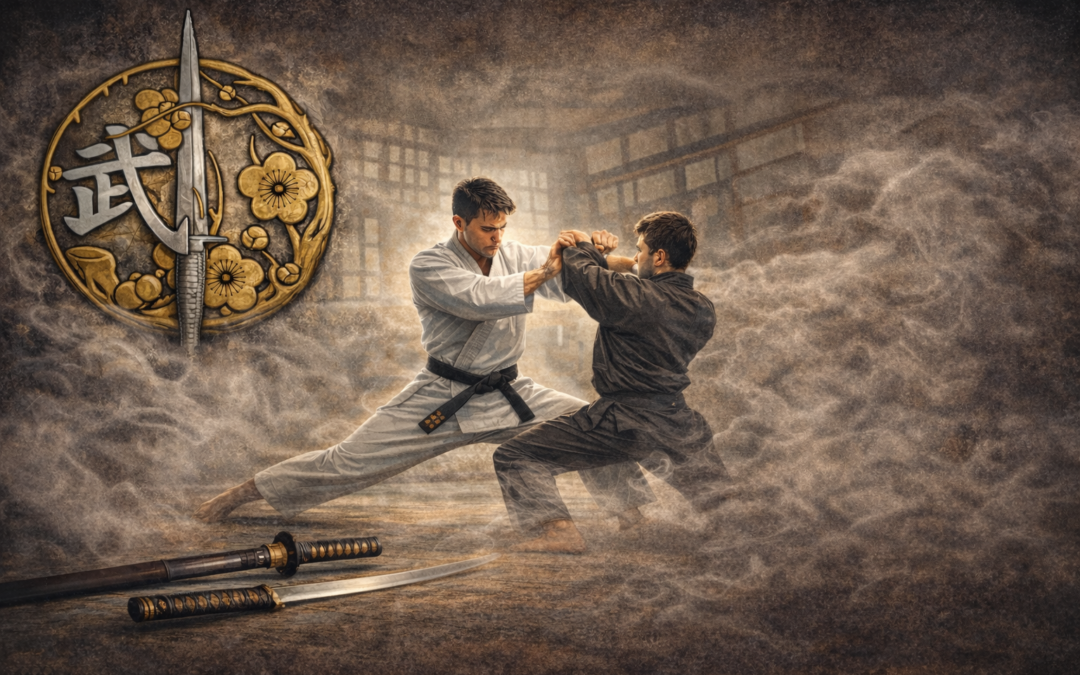
Strategy of Kasumi Ryu
Combat is the result of two independent forces each trying to impose its will on the other through violence of action, and does not end until one party has lost the will to resist. It is important to first recognize the concept of two independent and reactive forces. When you attack a target it does not see you coming and move to defend itself or counterattack. A living, breathing enemy will not only react to your attack, but will anticipate and actively seek to disrupt or preempt your opportunity to succeed. Additionally, he will be maneuvering to gain an advantage and launch his own attack to defeat you. Heiho, strategy, is the means employed to meet this goal, and is achieved by placing the opponent in a physical dilemma or by mentally overwhelming him.
A dilemma is a situation where the enemy must react to a threat or he will be defeated, injured, or killed. However, in reacting to the first threat the enemy exposes himself to another threat. Historically, this is a situation that was sought on the battlefield through the use of archers and cavalry. If the infantry advanced in an open formation they were exposed to the highly effective attacks of cavalry who were able to successfully destroy the infantry from horseback. In order to avoid a cavalry attack the infantry would have to move in tighter formations and “form square”, which was a four sided formation that the cavalry could not route. But when the infantry would form square they were exposed to fires from the archers, and later canon fire.
This same effect is achieved in a thousand ways in individual combat. One such example is when a person is choked, if they do not react to this threat they will pass out. If they do react they expose themselves to another threat such as a broken bone or dislocated joint.
“Therefore when you want to do battle, even if the opponent is deeply entrenched in a defensive position, he will be unable to avoid fighting if you attack where he will surely go to the rescue” – Sun Tzu, The Art Of War.
An adversary is overwhelmed when the series of events occur at a faster rate than they are able to mentally process. This mental process is now referred to as the Boyd’s Cycle. Colonel Boyd attempted to describe the mental process faced by fighter pilots and how events were able to overwhelm them. The process entails four parts: observe, orient, decide, act. When an adversary is constantly caught in the observe and orient modes they may not act at all. In other circumstances they will make it to the act phase, but find the situation has changed and their action has no effect. This does not mean that the person who is physically faster will overwhelm the other. Speed may be achieved through positioning and efficiency of movement. Dominance may also be achieved through kyojitsu ten kan ho (deception strategy) which presents an adversary with a false opportunity.
“So in the case of those who are skilled in attack, their opponents do not know where to defend. In the case of those skilled in defense, their opponents do not know where to attack” – Sun Tzu, The Art of War.
Throughout the world the primary reaction is to meet force with force. The influence of Taoism and its concept of balance may be what lead to the Japanese tactic of blending with an opponent’s actions. This provides a means of defeating the enemy based on efficient, adaptive movement. In many ways this movement may be imperceptible to the attacker until it is too late. This is accomplished by matching the speed, timing, and rhythm of the opponent so closely that they are unable to distinguish the minimal influence you exert that changes the end result.
“Be extremely subtle, even to the point of formlessness. Be extremely mysterious, even to the point of soundlessness. Thereby you can be the director of the opponents fate” – Sun Tzu, The Art of War.
It should not be necessary to force a particular technique on an adversary. By being well versed in the full spectrum of techniques available, a combatant will be able to capitalize on any given opportunity without having to seek a specific situation. Additionally, the combatant will be able to minimize the effectiveness of a variety of attacks through the use of body positioning and footwork. The basis of jujutsu is the posture of the fighter. This is not a static position but a series of transitory positions that serve as a platform for the fighter to conduct his attack or defense. This foundation is based on the ability to control ones balance sufficiently enough to influence the balance of the opponent.
“So a military force has no constant formation, water has no constant shape: the ability to gain victory by changing and adapting according to the opponent is called genius” – Sun Tzu, The Art of War.
The Heiho of Kasumi Ryu Sogo Bugei is to close with an adversary in a manner that allows the practitioner to achieve positional dominance. From the advantage of a superior position the practitioner will create a dilemma and end the confrontation by rendering the adversary unconscious or by injuring them in a manner that neutralizes the threat.
The wide variety of responses can range from basic escape and avoidance techniques, to non-lethal methods of control, extending to incapacitation and limited injury, and finally to a lethal or crippling response if necessary.