
Introduction
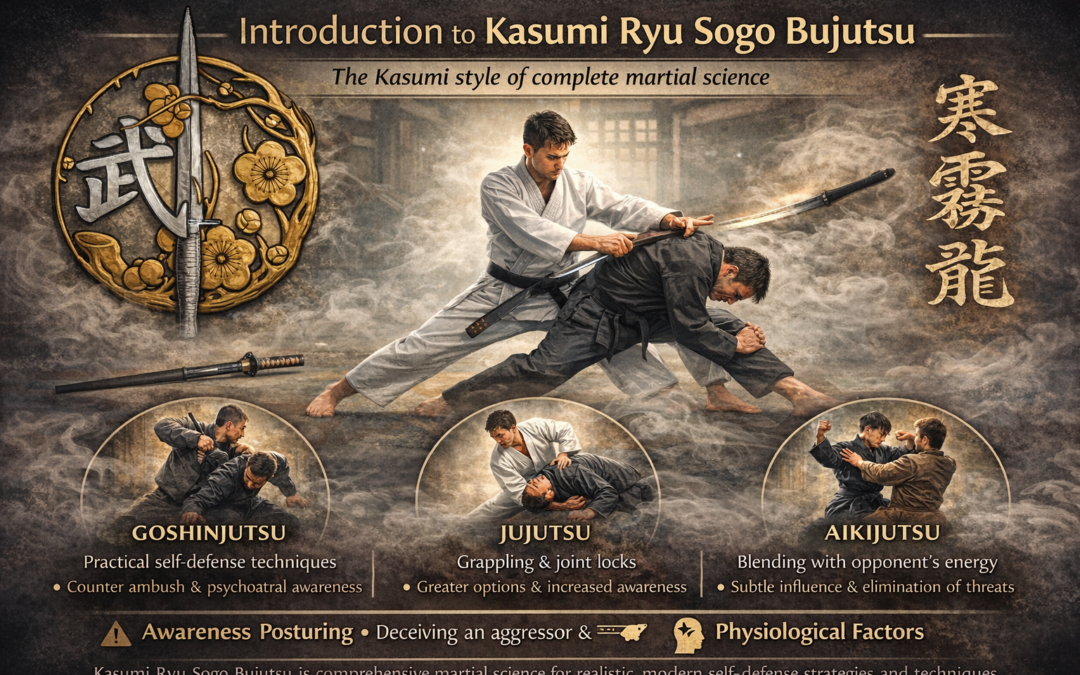
Kasumi Ryu Sogo Bujutsu, the Kasumi style of complete martial science. Kasumi is a mist, and alludes to an elusive nature which the student strives for. This effect is achieved through mastery of timing, distance, balance, and blending with an opponent’s energy.
Kasumi Ryu teaches three components of martial science. Goshinjutsu are the practical self-defense techniques that enable a person to recover from an ambush and counter attack. Emphasis is placed on conflict psychology, and the use of gross motor skills. Jujutsu is the second component and provides greater options for the practitioner to deal with conflict. Emphasis is based on increasing awareness, physiology, and ensuring the student is able to defend themselves under a variety of conditions. Aikijutsu is the third martial science enables the student to blend with an opponents attack. Emphasis is placed on subtle influence of the adversary before the attack through elimination of the threat.
In the lower kyu ranks goshinjutsu makes up the bulk of the instruction, with little instruction on aikijutsu. By the time the student makes it to black belt the three components are evenly divided. As the student progresses beyond black belt the training is increasingly aiki based. Although aikijutsu is the most sophisticated and desirable method we teach it also requires a great deal of time to become effective as a method of self defense.
Seventy-four percent of adults who have practiced martial arts in North America did so for reasons other than self-defense, such as fitness, self-confidence, or simply as a social activity. The goal of Kasumi Ryu Sogo Bujutsu is to provide realistic strategies against a variety of modern threats, armed or unarmed, standing or on the ground, with or without modern or improvised weapons.
Awareness
A person’s first line of defense is their awareness. Being aware of the limited range of realistic possible attacks helps a person tailor their training to a reasonable number of responses. By analyzing these possible attacks, a person learns the pre-contact cues that will enable them to respond earlier or avoid the attack all together.
Stress inoculation occurs when someone is so familiar with a circumstance that it no longer induces an over-whelming response in the individual. One of the principle ways Kasumi Ryu seeks stress inoculation and recognition of pre-contact cues is by practicing countless variations of a single technique with multiple partners at a pace that develops reflexive response. As each attacker closes the distance and attacks in quick succession, they display natural pre-contact cues allowing the defender to develop a meta-cognitive catalog of experience to draw from.
Role playing is used to create the most realistic training scenarios possible enabling the defender to recognize how persons may need to position themselves in order to affect certain attacks, or how their focus may be indicative of their intent. Verbal assault is practiced for additional emotional stress inoculation.
Posturing
Most often posturing refers to someone who presents themselves in a manner to intimidate another. For our purposes, posturing is performed to deceive an aggressor into believing we do not pose a threat. Through the use of non-aggressive postures and verbal defense skills we are able to better position ourselves for eventual combat without giving the aggressor a reason to elevate his level of control during his initial attack. It is more likely that an attacker will relax his grip, lower his, knife, or redirect his attention if he feels he is firmly in control of the situation and the victim poses little threat. Posturing in this manner may also give the defender the opportunity to go on the offense before the adversary commits to physical violence.
Offensive combat is warranted when it is consistent with the level of force presented or reasonably expected based on the threat.
Physiological Factors
Humans have an innate ability to survive threatening situations which has kept our species alive through the ages. These abilities are instinctive and impossible to over-ride, although many martial systems attempt to do so. Martial systems often develop immediate action responses based on complex motors skills, which unfortunately are not available during the initial stage of confrontation while under duress.
The first innate ability is the flinch. When an object threatens us we instinctively place our hands between ourselves and the threat, we flinch and often turn away slightly. Instead of attempting to reprogram our instincts, we accept that this is a natural and desired response and refine it to allow us to better survive the initial contact stage with an aggressor.
Our second innate ability is often referred to as the fight or flight response. When faced with a physical threat, or in anticipation of a physical threat, vision, cognitive processing, and fine motor control may all be degraded. When the sympathetic nervous system takes control it dilates pupils, relaxes the bronchi in the lungs, accelerates and strengthens the heartbeat, inhibits digestion, stimulates the release of glucose by the liver, secrets adrenaline, and relaxes control of the bowels. Negative effects may include tunnel vision, auditory exclusion, loss of fine or complex motor control, irrational behavior or the inability to think clearly. Positive effects may include increased blood flow to large muscle mass increasing strength and enhancing gross motor control, vasoconstriction of minor blood vessels at the ends of appendages which reduces bleeding from wounds, increased heart rate and improved respiration, and a sense of anxiety.
Utilizing these two innate abilities we accept that in the initial stage of an attack we will instinctively flinch to defend ourselves, and that our best defenses will be those that involve gross motor skills. We use those gross motor skills to achieve a point of domination at which time we are able to disable or injure the attacker to allow our escape. Only in this later stage can we expect to be able to use fine or complex motor skills.
Additional Psychological Factors
“Bitch, don’t scream and I won’t cut you!” Why would anyone take the word of an assailant? Everyday victims cooperate with an attacker because they are overwhelmed by an attack and they just want it to be over. Unfortunately, it often ends much worse and far different than what the attacker promised.
Know what you are fighting for. Prior to an engagement it is imperative that you are absolutely sure of what it is that will make you fight. Determine those things in your life that will be affected if you are not there for them, or if you are physically, mentally, or emotionally scarred from the attack. Very often other things in someone’s life are much more important to them then what they expect to be temporary pain. Identify what it takes for you to reach a level of indignation that makes you defend yourself. For example, a mother may fight harder to defend her child then she would to defend herself.
Understand that assailants are well practiced and are using tools, techniques, and tactics that have worked for them in the past. You have to be prepared to act in the instance they make a mistake. Your action has to be decisive and resolute. It may be your one opportunity. The only way you will be able to recognize an opportunity is if you get challenged instead of getting threatened. How do you know the difference? If you are focusing on what to do if given the chance, you are challenged. If you are focusing on anything else you are threatened.
Structure of Kasumi Ryu
Kasumi Ryu is a martial art based on three primary skill areas and the many lesser included arts that provide flexibility in thought and response. The objective of Kasumi Ryu is to provide a means for personal growth based on physical and mental conditioning utilizing realistic self defense methods, traditional weapons, and meditative arts built around the moral basis provided by bushido, the “way of the warrior”. Developed in Japan between the 9th and 12th centuries, the code of bushido emphasizes honesty, respect, justice, and self-control.
The first skill area is jujutsu, the unarmed skills which form the foundation for the entire art. Jujutsu is the basis for both offensive and defensive movement. The term is used to describe a variety of Japanese fighting styles however most involve the use of joint manipulation and throws to gain advantage over an adversary. Kasumi Ryu Jujutsu is comprised of the following sub-arts: ukemi (falling and rolling skills), atemi (striking skills), kansetsu (joint manipulation skills), shime (oxygen deprivation skills), nage (throwing skills), katame (grappling skills), and hajutsu (countering and escaping skills).
The second skill area is bojutsu, the use of stick and staff weapons. Building on principles and movement learned in jujutsu, bojutsu teaches the use of a variety of blunt weapons for defense. Kasumi Ryu Bojutsu is comprised of the following sub-arts: bojutsu (the use of the six-foot staff), jojutsu (the use of the four-foot staff), hanbojutsu (the use of the three-foot half staff), tanbojutsu (the use of a variety of short sticks including the tessen (fan), and the jutte (truncheon)). Advanced students will receive training in sojutsu (the use of the spear), and in naginata jutsu (the use of the halberd).
The third skill area is kenjutsu, the use of the sword. Again, based on the principles and movement learned in jujutsu, kenjutsu teaches the use of a variety of edged weapons for defense. Kasumi Ryu Kenjutsu is comprised of the following sub-arts: kenjutsu (the use of the long and short sword), iaijutsu (the ability to quickly draw the sword in defense), tantojutsu (the use of the knife), and shurikenjutsu (the use of a variety of throwing blades).
Historically, samurai were said to have mastered the bugei juhappan, 18 martial arts. These arts varied according to the time period and needs of the warrior, however several of these arts have found modern application within Kasumi Ryu. Participation in these arts are not required to progress in Kasumi Ryu but are offered for those interested students. Arts such as hojojutsu (binding an adversary with cord), chikujojutsu (castle fortification applied to home security), tenmon and chimon (meterology and field skills applied to wilderness survival), shinobi no jutsu (movement, escape and concealment methods applied to self defense), choho (espionage applied for self defense and to defend against identity theft), suiren (survival and combat skills in water), kusarigama (the use of the chain and sickle), kusarifundo (the use of the weighted three-foot chain), and hojutsu (the use of firearms for self defense).
Each skill set is perfected through waza, kata, and randori.
Waza are the individual techniques of the art. The purpose of waza is to teach the student the principles and correct execution of the art. All techniques in Kasumi Ryu are based on structural control of the adversary through the communitive locking of joints, circumnavigation around points of resistance, triangulation to off-balance, and energy transfer. Henka are the countless variations of each waza.
Kata are a series of preset two-person routines. The purpose of kata is to provide a variety of examples allowing the student to see a practical sequence of waza which reflect the heiho, or strategy of the art.
Randori, is free-movement. The purpose of randori is to allow the student to learn timing, distance, and rhythm. All randori will revolve around realistic scenario based threats with the aggressor committing to a particular type of attack for the first thirty seconds.
The following excerpt is by Dr. Karl F. Friday, and provides an excellent analysis of how waza, kata, and te-no-uchi (developed through randori) form the basis of martial arts.
In combat a warrior must neither stubbornly resist nor surrender to the force exerted by his opponent. Rather he must neutralize it, offset it exactly so that the net application of strength between himself and the opponent is zero. From this state of equilibrium, which resembles the poise of the two sides of the scale, the warrior can easily move the opponent about and defeat him by applying only a tiny additional force – in the same way that one can easily raise, lower, or swing even the heaviest objects resting in the buckets of a balanced scale. “Aiki,” or “reciprocal spirit,” represents the spiritual and psychological aspects of this same skill, the ability to neither intimidate nor be intimidated by the opponent.
In combat, however, both speed and power are relative considerations; the absolute power and speed of which a warrior is capable are of less importance than his speed and power relative to those of his opponent, and even this is relative. For what matters most is not which opponent is faster or more powerful, but which is faster or more powerful at the critical moment in which a blow is delivered.
The most efficient means for the warrior to reduce the time he needs to reach the critical level of speed and power is to lessen the difference between this critical velocity and his critical velocity at the start of the technique. Kashima-Shinryu masters therefore insist that a warrior in combat never reach a state of absolute immobility, as this would maximize the time it takes to accelerate to the speed (and therefore the power) needed to best his opponent.
Bugei instruction prescribes a gradual, developmental process in which teachers help students to internalize the key precepts of ryuha doctrine. Understanding – mastery – of these precepts comes from within, the result of the student’s own efforts. But the teacher presents the precepts, and creates an environment in which the student can absorb and comprehend them from without.
(Kata) Variously described as a kind of ritualized combat, exercises in aesthetic movement, a means to sharpen fundamentals such as balance and coordination, a type of moving meditation, or a form of training akin to shadowboxing, kata embraces elements of all these characterizations, but its essence is captured by none of them.
Fundamentally, kata represents a training method wherein students rehearse combinations of techniques and counter techniques, or sequences of such combinations, arranged by their teachers.
One of the key points to be understood about pattern practice in the traditional bugei is that it serves as the core of training and transmission.
The essential knowledge – the kabala – of a ryuha can be broken down into three components: hyoho – or heiho – (“strategy”), te-no-uchi (“skill” or “application of skill”), and waza (“techniques” or “tactics”)
As such, “hyoho” designates the general principles around which a ryuha’s approach to combat is constructed: the rational for choosing between defensive and offensive tactics, the angles of approach to an opponent, the striking angles and distances appropriate to various weapons, the proper mental posture to be employed in combat, the goals to be sought in combat, and similar considerations. “Te-no-uchi” constitutes the fundamental skills required for the application of hyoho, such as timing, posture, the generation and concentration of power, and the like. “Waza” are the situationally specific applications of a ryuha’s hyoho and te-no-uchi, the particularized tactics in and through which a student is trained. Waza, te-no-uchi, and hyoho are functionally inseparable; hyoho is manifested in and by waza through te-no-uchi.
Mastery of pattern practice is not the same as mastery of the art: A students training begins with pattern practice, but is not suppose to end there. Kata are not, for example, intended to be used as a kind of database mechanically applied to specific combat situations. Rather, pattern practice is employed as a tool for teaching and learning the principles underlying the techniques that make up the kata. Once these principles have been absorbed, the tool is to be set aside.